
Blog · Field Notes
CategoryIndustryEmergent Memory Systems let AI agents and teams carry experience forward through activation, reinforcement, forgetting, revision, and review.
Emergent Memory Systems
Summary Capsule
Emergent Memory is a category of AI memory system where useful context forms through repeated work, reinforcement, forgetting, revision, and review instead of being manually stored as static knowledge.
In a post-AI organization, emergent memory matters because agents and teams need experience to compound over weeks and months, not merely retrieve documents inside one prompt.

Emergence begins when inert parts start to organize, reinforce, and change what happens next.
Memory != storage.
We treat remembering and storing as the same operation. They are not.
Ephemeral means keeping state while a program runs. Persistent means keeping data long after the program stops. Early computing gave us these two abstractions, and the split has shaped almost every software product and computer system since the 1950s. Neither abstraction is memory.
Storage keeps information. Memory changes future behavior.
A hard drive stores files. A database stores records. A vector index stores embeddings. None of these things remembers anything on its own. They only hold data.
Consider an AI assistant that has worked with a product team for six months.
Over time, it sees the team reject complex operational changes, learns that one customer needs special handling, and notices that small reversible changes usually win over large refactors.
When a new planning question arrives, none of those facts may appear in the prompt. A storage system can preserve them. A retrieval system can find them if asked the right question.
Memory does something stronger: it changes what the system considers relevant before it reasons.
Leonard Shelby in Memento shows the difference.

Leonard Shelby, played by Guy Pearce, in Memento (2000). Written and directed by Christopher Nolan. © Newmarket Films.
He surrounds himself with durable artifacts: notes, photographs, and tattoos.
They persist. They store information. But persistence alone does not give him memory. The artifacts do not tell him which clue deserves trust. They do not show what changed. They do not help him revise an old conclusion. The missing piece is the machinery that turns stored experience into future influence.
Shelby has no Continuity over Time.
That is the difference. Storage preserves information. Memory changes what the system does next.
Memory pilots intelligence.
Memory as Pilot
Many AI systems have Shelby's problem. They can reason well, but still fail when nothing decides which past experience should matter now.
Memory is not a data retrieval system you can call up and use. It is not a vector database, a proximity store, or a knowledge graph. We do not store data in rows and columns in our minds to query later.
This distinction mattered less when software followed fixed instructions. It matters now because AI systems act less like fixed programs and more like people using judgment. They answer, decide, plan, and revise.
Memory works differently from storage. It changes through reinforcement, abstraction, decay, and reconstruction.
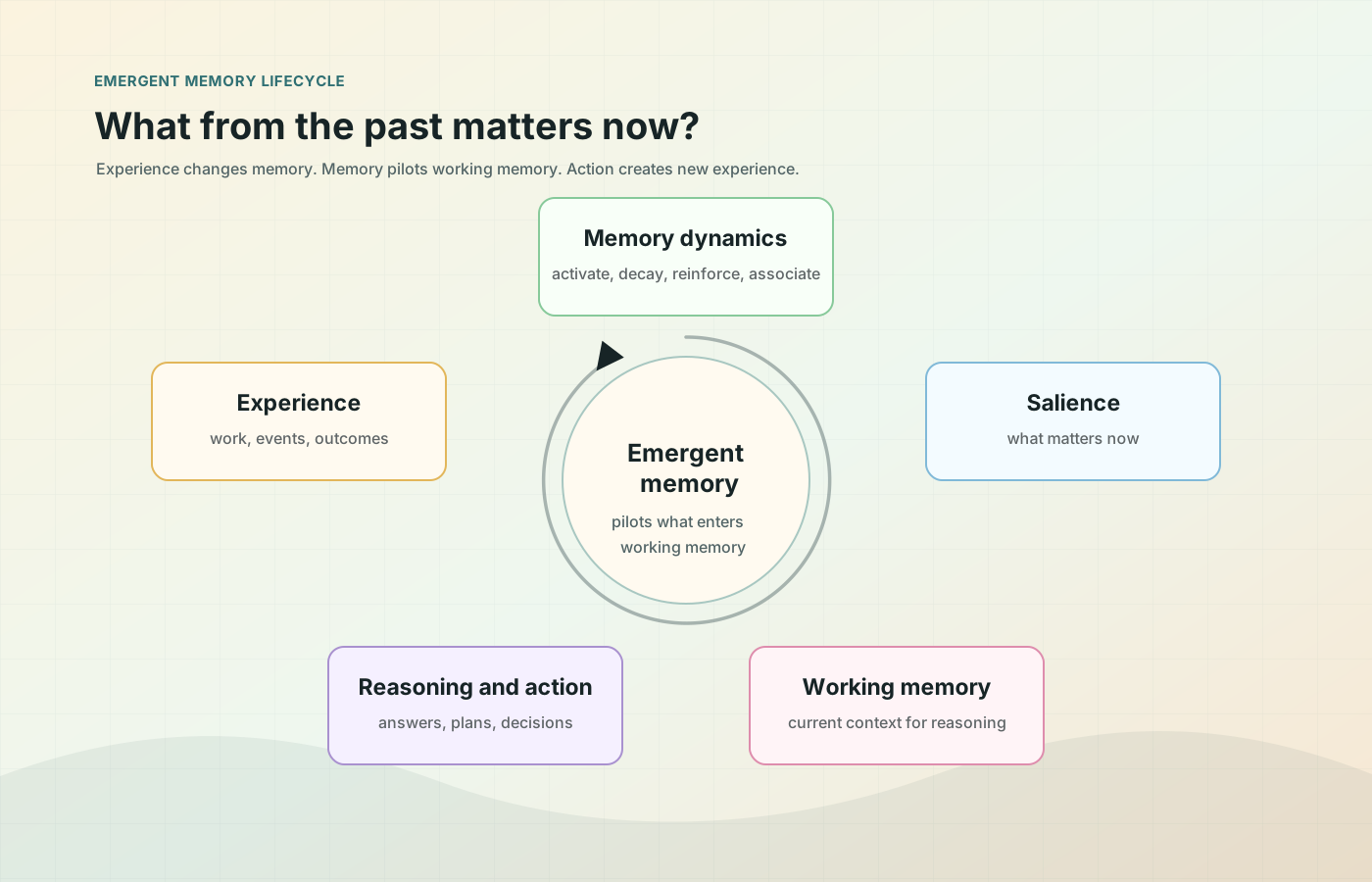
Emergent memory sits between accumulated experience and working memory, deciding what becomes available to reason about.
Memory is also different from working memory. Working memory holds what the model can think about now.
But it does not decide what from the past should matter now.
That is the role of emergent memory: it pilots what enters working memory.
It can also steer reasoning by shaping goals, constraints, and self-correction.
Retrieval asks: what stored information resembles this request?
Memory asks: what from the past should influence this decision?
That is why emergent memory is not just automatic RAG. RAG retrieves information when prompted. Memory changes what becomes salient before the prompt has fully specified what matters.
Memory as Emergence
At Achiral, we call this Emergent Memory. It sits between accumulated experience and working memory, deciding what gets activated, reinforced, forgotten, associated, and surfaced.
That makes memory broader than retrieval, but narrower than any past influence.
Memory is a persistent change in the state of a system caused by prior experience that alters the system's future behavior, responses, or internal dynamics.
Experience → State Change → Changed Future Behavior
In plain terms:
A system has memory when past experience changes what becomes salient, and therefore changes what it is likely to do next.
For technical readers, the same claim can be written as:
Where:
- is the internal state of a system at time
- is a persistent modification to that state caused by experience
- is future behavior or output at a later time
- is a change in the probability distribution of future responses
In this sense, memory is compressed experience that can be drawn into context when it matters.
The model does not query memory once and move on. It reasons with memory. The current context activates some memories, those memories reshape the context, and the new context can activate more memory.
This is a kind of co-inference between model and memory: a recursive loop of context, activation, and reasoning. It feels natural because one relevant thing brings another into view.
Memory as Constitution
If memory changes what a model does next, memory is in the driver's seat. I do not think AGI is possible, or safe, without coherent memory in that role. Most frontier labs run models inside some kind of constitution: guardrails, red teaming, oversight, or policy frameworks. That work matters, and model breakouts have been rare. Still, a constitution enforced from the outside is closer to a cage than a social contract.
Even agent frameworks like LangGraph, CrewAI, AutoGen, or GStack can mimic the conditions around a model. But those tools need maintenance. They can give an agent durable state, but not temporal continuity. They are closer to Leonard's Polaroids, tattoos, and notes: artifacts he uses to reconstruct his Context of Reality.
The goal is not to copy human memory exactly. We want storage-grade recall plus experience-shaped judgment.
At Achiral, we think emergent memory is the right answer: a fallible organic memory that forms through experience over time, and uses forgetfulness as a distillation technique to maintain contextual coherence.
Forgetting is not the failure of memory. It is part of memory's function. A system that preserves every experience with equal weight eventually loses the ability to distinguish signal from noise.
Research preview
Read our preprint on Jacobian-Causal Memory Control, which treats memory recall as an observed, auditable intervention on model behavior. If memory can move model behavior, recall becomes a simple intervention.
Anthropic's essay on global workspace in language models points in a nearby direction. When Anthropic prevented Claude from using its J-space, Claude kept many basic abilities but lost higher-order reasoning. At Achiral, we view workspace as one place where emergent memory can steer behavior.
Unlike model weights, memory is not immutable. We can inspect, revise, forget, or share it. That makes memory less like static parameters and more like a living layer with its own lifecycle. Over time, emergent memory forms a higher-order gradient. The system can draw inference from that gradient, not only from the current prompt.
Memory as a Research Frontier
Emergent Memory at Achiral is not starting from nothing.
Among the many frameworks available, we started with ACT-R framework as our primary inspiration. Achiral does not treat memory as a passive store. Our solution activates, reinforces, forgets, and retrieves in context.
There are many cognitive architectures that point in other useful directions. Soar studies problem solving and learning. Sigma tries to unify symbolic reasoning, probability, and learning. Leabra and Emergent model cognition through neural dynamics. Spaun and the Semantic Pointer Architecture show how large-scale cognitive behavior can arise from distributed neural systems.
None of these frameworks gives us a product blueprint. But together, they point toward the same frontier: a new kind of memory that is fundamentally emergent. One that forms through experience, changes what becomes salient, and helps long-lived AI systems act with continuity.
Memory as Gold Rush
When this frontier moves from research into products, it raises a hard ownership question.
Who owns the memory that emerges through experience? And can they take it with them?
As Achiral's founder, I have spent a lot of time on ownership and portability. I believe personal memories belong to people. Work memories belong to the businesses that use an emergent memory to steer AI at work.
No single corporation should be able to take that ownership or portability away.
To support this, we have drafted an open format for Generated Emergent Memories, or GEMs. We will cover that in a separate post.
Memory as an Industry
A new industry is forming around long-lived AI systems.
Bigger models, smarter prompts, and longer context windows will keep improving. But memory will decide how these systems carry experience forward: how it forms, how it steers behavior, who owns it, and how it moves across systems.
If AGI means intelligence that carries experience across domains, then emergent memory may be what makes it general.
At Achiral, we are building ACT-R-inspired memory infrastructure for that future. If memory and its applications in AI excite you, and you want to help build the future of emergent memory, reach out to me at marvin@achiral.ai. We believe in making memories together.
Emergent Memory is the layer that lets agents, teams, and long-lived AI systems carry experience forward.
Read next
A monthly trip down memory lane
Subscribe to our newsletter on memory, intelligence, emergence, life, and the pursuit of being less wrong. Handwritten. Once in a month.