
Concepts · Humans and machines
A memory-native organization has a shared way to remember what happened, why it mattered, who can use it, and when it should affect the next action.
What Is a Memory-Native Organization?

A memory-native organization has a shared way to remember what happened, why it mattered, who can use it, and when it should affect the next action.
The point is not better document storage.
It is closer to an air traffic control tower for work.
The tower does not remember every detail forever. It keeps the current situation clear enough that planes can move safely. It knows what is in the air, what is on the ground, what has clearance, what is waiting, and what just changed.
A memory-native organization does the same for work. It keeps enough trusted context current so people and agents can continue without starting from zero, colliding with old decisions, or asking everyone to explain the past again.
That does not mean every organization should centralize all information. It does not mean memory automatically creates better decisions.
The value comes from the architecture: what gets captured, who may use it, when it comes back into view, and when it expires.
The architecture
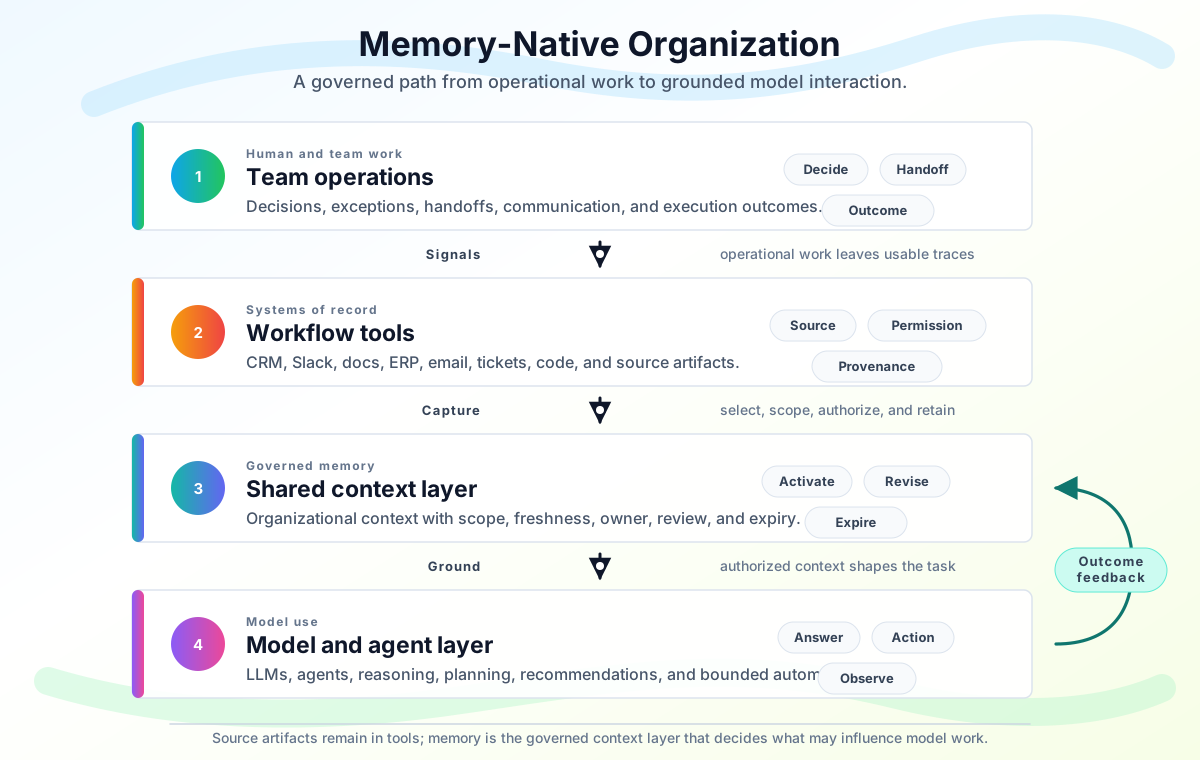
A four-layer reference architecture. Operational work and tools produce signals. A governed context layer selects and organizes what may influence model interactions; outcomes then provide evidence for revision or retirement.
| Layer | Job | Design question |
|---|---|---|
| Team operations | Work creates decisions, exceptions, handoffs, and outcomes. | Which work creates context worth preserving? |
| Workflow tools | Email, tickets, CRM, code, docs, and meetings hold the source artifacts. | What may be connected, and under which permissions? |
| Shared context layer | The memory layer selects, scopes, retrieves, revises, and retires context. | Why is this retained, who may use it, and when should it expire? |
| Model and agent layer | People, models, and agents use authorized context to answer or act. | What context is needed for this task, and how is its use observed? |
The important boundary is between the source artifact and the memory derived from it.
A ticket, document, meeting note, or code review remains the source. A memory is a scoped representation of that source. It should keep provenance, permissions, freshness, and owner attached.
Without that boundary, memory becomes mush. A summary floats away from its source. A stale decision looks current. A model response becomes "knowledge" merely because it was generated.
The Lifecycle
Storage asks:
Where is the artifact?
A memory layer asks:
Should this information influence this task now?
That requires a lifecycle:
- Capture a signal from an authorized source.
- Assess its evidence, owner, scope, and sensitivity.
- Make it retrievable only for appropriate people, agents, and tasks.
- Revise, supersede, or withdraw it when the underlying situation changes.
- Record enough provenance to explain why it influenced an answer or action.
The lifecycle is what makes the organization memory-native.
Capture is not enough. Storage is not enough. Search is not enough.
Simple ACT-R Map
A governed context lifecycle
Capture is not retention; retrieval is not authorization; feedback is not automatic truth.
- 1
Signal
Authorized work creates evidence
Work artifact
A decision, ticket, document, or handoff.
- 2
Assess
Scope and validate context
Scoped context
Source, permissions, freshness, and owner.
- 3
Use
Retrieve only for a task
Task context
Relevant, authorized information only.
Answer or action
A model or person uses the context.
- 4
Review
Correct or retire context
Outcome review
Accept, correct, supersede, or expire.
What to evaluate
A memory-native organization should be judged by whether the work gets better, not by how much it stores or how many model calls it makes.
Useful tests are simple:
- Do people repeat themselves less?
- Are handoffs more complete?
- Does the system retrieve context with the right permissions?
- Can a user see where a memory came from?
- Can wrong or stale context be corrected or removed?
- Do agents act with the right evidence instead of generic context?
The failure modes matter too:
- stale summaries
- wrong entity links
- over-broad retrieval
- missing provenance
- leakage across access boundaries
- feedback loops that preserve an early mistake
A model response should not become durable context merely because it was generated. Retention needs evidence. Sometimes it needs human review.
Design principles
- Preserve source artifacts and attach provenance to derived context.
- Enforce permissions before retrieval, summarization, and action—not after.
- Make scope, freshness, and confidence inspectable to users.
- Prefer revision and expiry to permanent accumulation.
- Start with one workflow where context loss is costly, then measure the change.
- Keep the model layer replaceable; organizational context should not be trapped in a single model vendor.
An implementation perspective
Achiral is designed as a shared operational-context layer within this architecture.
It uses retrieval, lifecycle management, permissions, and review to help teams reuse relevant context across work. These are engineering capabilities, not evidence that a system has human memory or that organizational learning is automatic.
The practical aspiration is continuity with accountability.
Less repeated discovery. Clearer handoffs. Context that can be inspected, corrected, or retired.
That is what memory should do inside an organization: help the next person or agent act with the right context, at the right time, for the right reason.
Continue with RAG vs AI Memory, ACT-R as Agent Memory, or Introduction to ACT-R.